How to Post on LinkedIn Consistently Without Burning Out (Even If You Have a Full-Time Job)
How to post on LinkedIn consistently means building a repeatable system that removes daily decision-making from the equation. Most people quit within two weeks, not because they lack ideas, but because they rely on motivation instead of structure. Posting three to five times a week is completely achievable with a full-time job once you batch, template, and automate the right parts.
Open your LinkedIn profile right now. Scroll down to your last post. If it was weeks ago, you already know the feeling: a count that stopped moving, opportunities passing to someone who just kept showing up.
The people who win on LinkedIn are rarely the ones with the most to say. They are the ones who figured out how to say it without it taking over their lives.
This guide breaks down exactly how they do it.
Table of Contents
- Why Most People Quit LinkedIn After 2 Weeks
- The Batching System: Write Once, Post All Week
- The 5-Post Starter Framework
- How AI Tools Can Help You Stay Consistent Without Sounding Generic
- Building the Habit: Your 30-Day Consistency Plan
- FAQs
Why Most People Quit LinkedIn After 2 Weeks
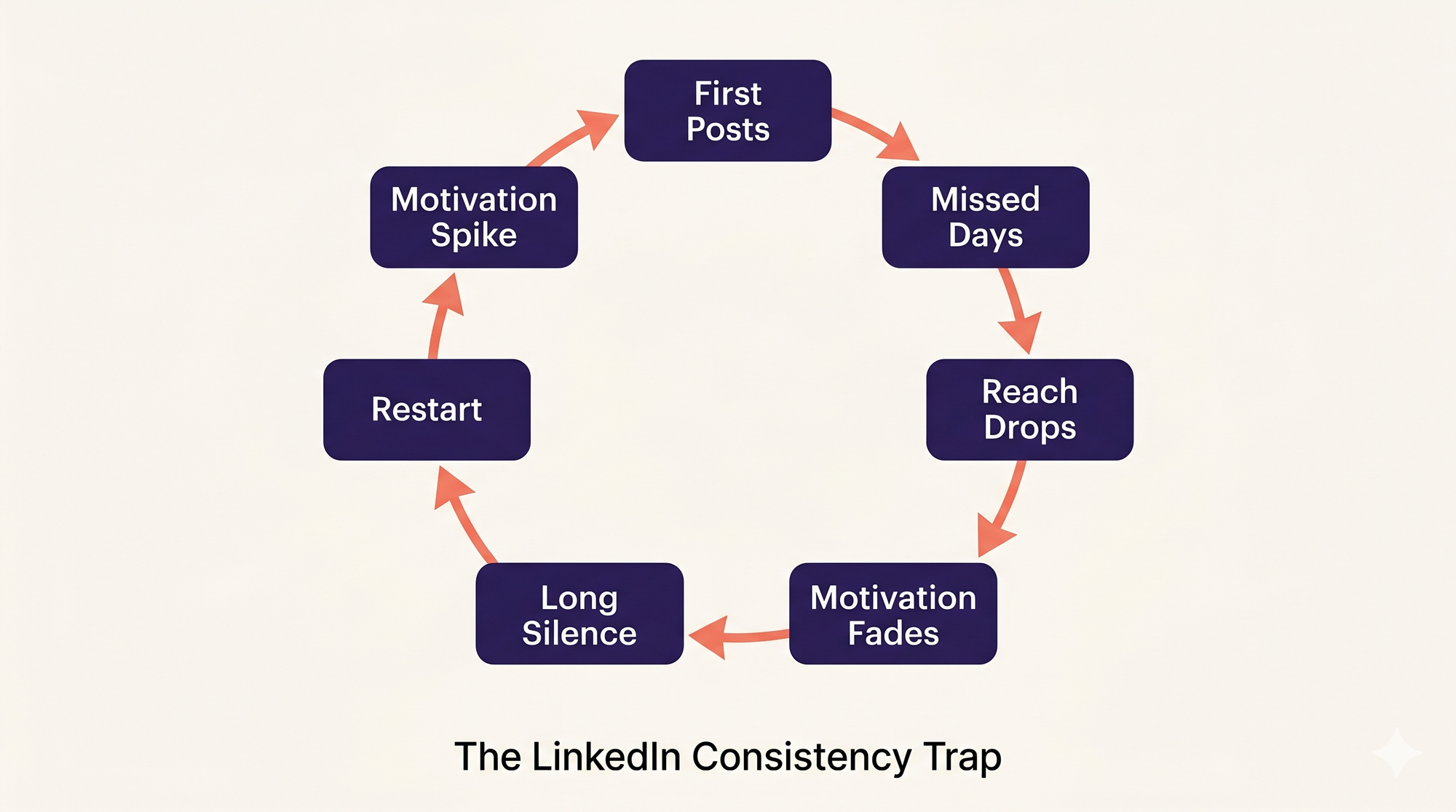
It always starts the same way. A post does well. A few comments come in, maybe a connection request, maybe even an inbound message. You think: I need to do this every day.
Then a deadline hits. A rough week. Two days pass without posting, then five. The streak breaks and picking back up feels harder than starting did.
This is the consistency trap. Nearly everyone who treats LinkedIn as a willpower challenge falls into it.
The real cost of going silent is that it compounds. LinkedIn's algorithm does not forgive gaps easily. When you disappear for two weeks, your reach drops. When reach drops, the next post starts from a lower floor. Motivation to try again shrinks because "it's not working anyway." Silence feeds on itself.
The fix is not posting every single day through sheer discipline. The fix is removing the daily decision entirely.
The Batching System: Write Once, Post All Week
Content batching is the most effective single habit shift for LinkedIn consistency. Instead of asking "what should I post today?" every morning, you sit down once a week and produce everything in one focused session.
A 90-minute block can generate a full week of content. Here is what that looks like in practice:
- 15 minutes: think back on the week (a win, a lesson, a conversation, something you read)
- 30 minutes: write three rough post drafts
- 20 minutes: edit and format them
- 15 minutes: schedule all three using a tool that publishes directly to LinkedIn
- 10 minutes: note two backup ideas for the following week
The key word in that list is "rough." Batching works when you stop trying to perfect each post before moving to the next one. Write all three drafts first, then edit all three. Switching between writing and editing modes mid-session kills momentum faster than anything else.
Templates are your blank-screen insurance. When you sit down to batch and nothing comes to mind, a template gives you a shape to fill in. A few that hold up well:
- The Lesson: "I used to think [X]. Then [event] happened. Now I believe [Y]."
- The Contrarian take: "Everyone says [popular advice]. Here is why I disagree and what I do instead."
- The Behind-the-scenes: "Here is what actually went into [project or result] that nobody talks about."
- The Quick win: "One change I made that produced [specific result] in [timeframe]."
These are not formulas to copy word-for-word. They are scaffolding. Fill in the brackets with something real from your life or work and you have a draft in under ten minutes.
The 5-Post Starter Framework
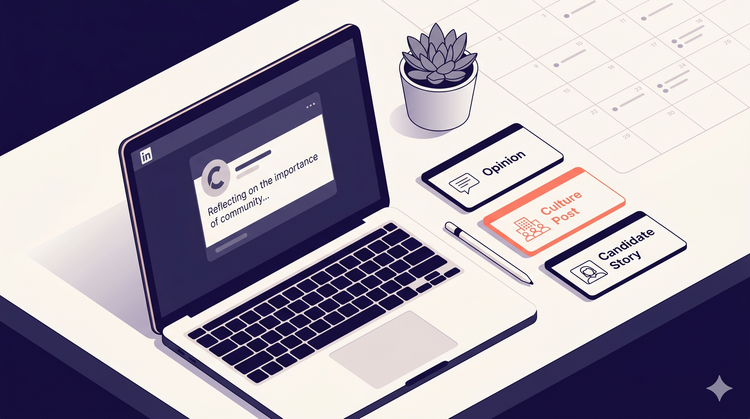
If you are starting from zero or picking back up after a long gap, five post types can cover a full week with minimal creative effort. Think of this as a rotation: one of each type per week, in any order.
1. One Insight Something you learned this week, from a book, a meeting, a failure, or a video. Keep it to a single point. Depth beats breadth every time. Example: "The most useful feedback I got this quarter came from someone who almost quit our product. Here is what they told me."
2. One Opinion A view you hold that not everyone shares. LinkedIn rewards genuine perspective far more than safe consensus posts. Example: "Posting every day on LinkedIn does more harm than good for most professionals. Here is why."
3. One Case Study or Story A real situation with a beginning, a conflict, and a resolution. It does not have to be a major win. A small decision with an interesting outcome works just as well. People read stories because they can picture themselves in them.
4. One Question Ask your audience something genuine. Skip "What do you think?" because it is too broad. Go specific: "If you had to cut your content creation time in half starting tomorrow, what is the first thing you would stop doing?"
Questions drive comments. Comments drive reach. They also hand you fresh ideas for the following week without any extra work.
5. One Repurpose Take something you have already made: a presentation slide, a long email, a comment you left on someone else's post that got traction. Turn it into a standalone post. You already did the thinking. This step just packages it.
Five types. One session. One week done.
How AI Tools Can Help You Stay Consistent Without Sounding Generic
AI tools have earned a bad reputation on LinkedIn. You can usually spot when someone let ChatGPT write their post. The hook sounds like a product brochure. The conclusion arrives with something like "In summary, it is clear that..." The voice has been averaged into nothing.
That is not a problem with AI. That is a problem with how most people use it.
The useful distinction is between AI that writes for you and AI that actually learns your voice. A generic chatbot gives you output shaped by the prompt. A personalized content workspace gives you output shaped by your tone, your niche, your history, and the way you naturally phrase things. The result sounds like you wrote it, not like a summary bot summarized the internet.
This is the gap that tools like CannerAI were built to close. Instead of handing you a blank text box, CannerAI takes a URL or topic, researches it, pulls the key insights, and drafts a post in your personal writing style. The more you use it, the more accurately it mirrors how you actually communicate.
The practical benefit for consistency is real. Most blank-screen anxiety on LinkedIn comes from having to solve two problems at the same time: finding something worth saying and writing it well. Research-to-post tools split those into two separate steps. You bring the topic. The tool produces the first draft. You edit it into your voice and publish.
Connect any YouTube channel and CannerAI automatically generates post drafts in your personal style whenever a new video goes live. You review, approve, and publish without watching the video or opening a single extra tab.
See how Connectors worksFor busy professionals who watch a lot of YouTube, this removes one of the biggest bottlenecks in the whole workflow. Instead of mentally filing away "I should write a post about that video" and forgetting it three days later, the draft is already waiting for you.
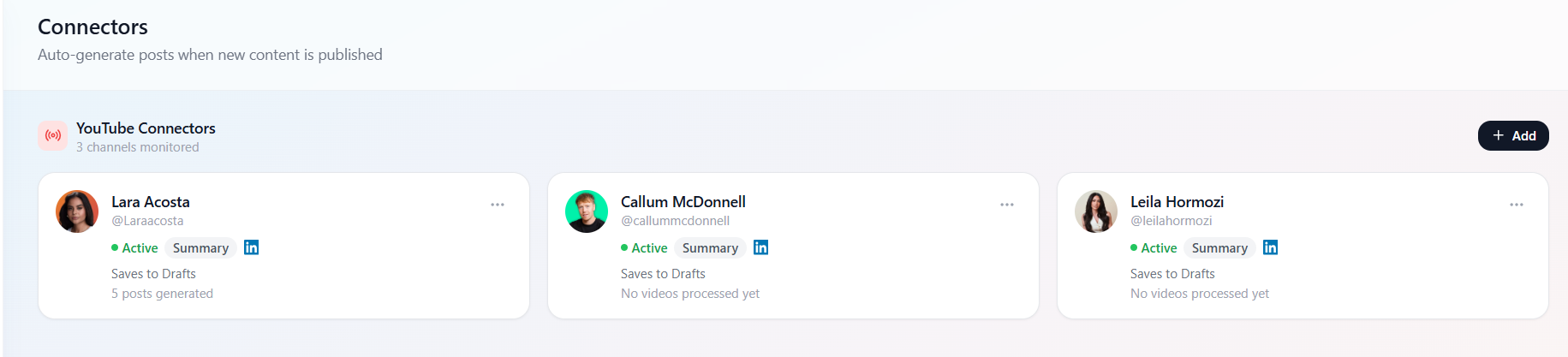
CannerAI's research-to-post pipeline turns any URL or topic into a LinkedIn post draft in your voice
The consistency benefit compounds quietly. When posting no longer needs a 45-minute session of reading, thinking, writing, and formatting from scratch, it becomes something you can fit into 15 minutes on a Tuesday morning. That changes everything.
If you are already evaluating LinkedIn tools, this comparison of AI tools for LinkedIn covers what is genuinely useful versus what just adds another tab to your workflow.
Building the Habit: Your 30-Day Consistency Plan
Streaks work when the bar is low enough to clear on a bad day. Committing to "post every day" sets the bar too high. Committing to "open my content folder and write one sentence" does not.
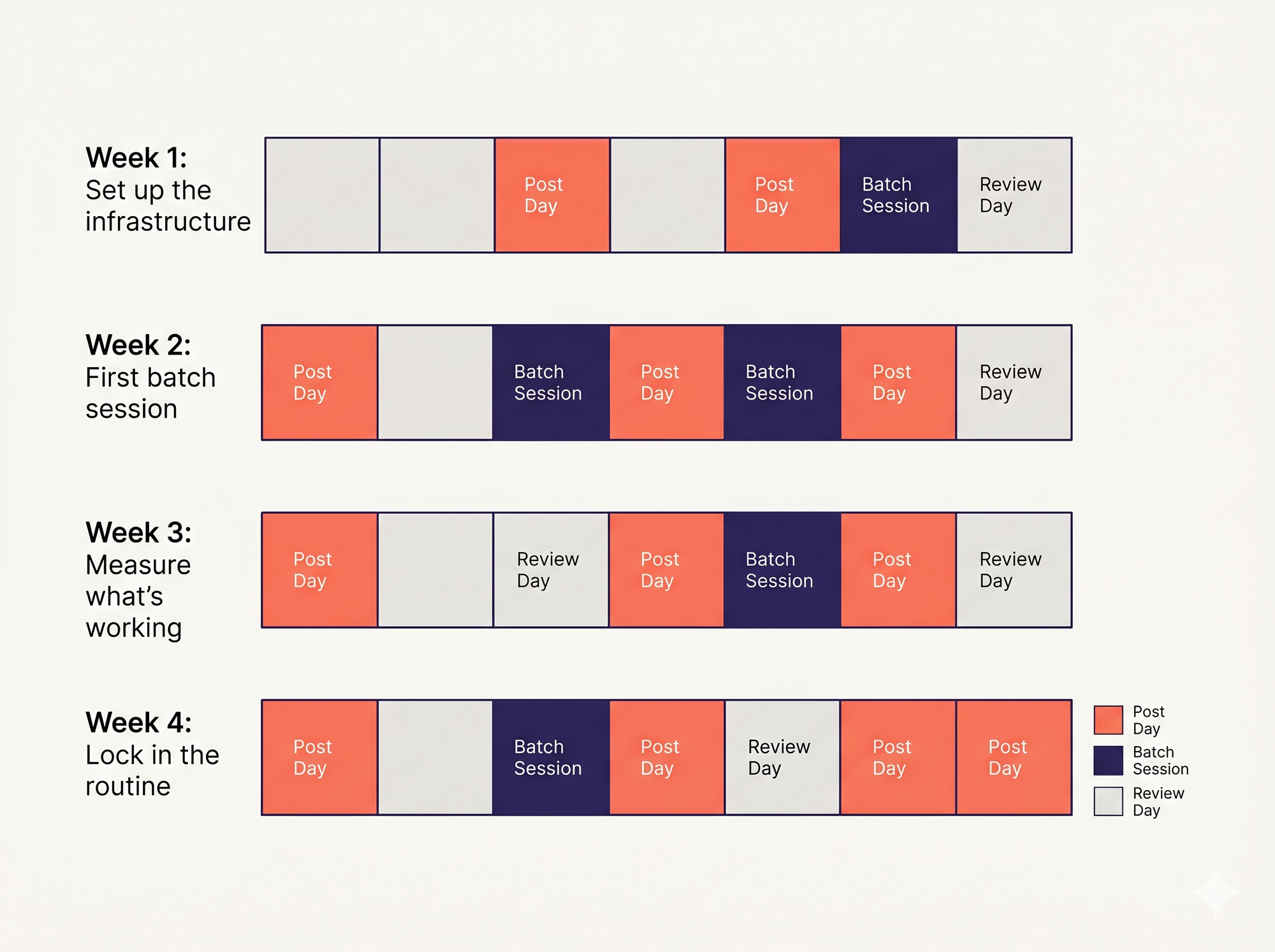
The 30-day plan below is built around one rule: show up on schedule, even when the output is small.
Week 1: Set Up the Infrastructure
- Create a single content folder in whatever app you already use (Notes, Notion, anywhere)
- Write down 20 post ideas without judging any of them
- Block one 90-minute batch session for Sunday or Monday
- Choose your cadence: three posts per week is enough to build momentum without burning yourself out
Week 2: Run Your First Batch
- Use the 5-post framework to produce five drafts in one session
- Schedule all five to publish over the next two weeks
- Add a recurring 30-minute "content review" block to your calendar every Friday
Week 3: Measure What Is Working
- Check which posts got the most engagement, not just likes but comments and profile visits
- Add three new ideas to your content folder based on what resonated
- Adjust: if your question post underperformed, maybe your audience prefers stories. Follow the data.
Week 4: Lock In the Routine
- Your second batch session should take closer to 60 minutes instead of 90. You are warming up to the format.
- Identify your highest-engagement post type and build two variations of it for the next cycle
- Notice where the friction sits in your workflow: writing, research, or publishing. That is where a tool actually helps.
What "consistent" actually looks like: After 30 days of posting three times a week, you will have published roughly 12 posts. Some will underperform. That is expected and it does not matter. The compound effect shows up at month three and month six, not week two. The first 30 days are foundation work, not results.
Accountability beats willpower every time. Find one other person who is also trying to post on LinkedIn, a colleague, a friend, anyone, and share your posting schedule with them. Knowing someone will notice if you go quiet is more effective than any app or productivity hack.
FAQs
How often should I post on LinkedIn to grow my audience?
Three times per week is the most sustainable posting frequency for consistent LinkedIn growth, especially if you have a full-time job. Daily posting can work, but it significantly increases the risk of burnout and quality drop. Consistency over several months matters more than high volume in short bursts.
How do I find content ideas for LinkedIn when I have nothing to say?
Start with what actually happened this week. A problem you solved, a mistake you made, a conversation that changed how you think about something, or an article that surprised you. Keep a simple running list in your phone's notes app. You rarely run out of ideas; you just lose them before you write them down.
Can I batch-write LinkedIn posts without them sounding scheduled?
Yes, with one condition: write in the same voice you would use explaining something to a colleague. Read each draft out loud before scheduling it. If it sounds natural, it will land. If it sounds like a press release, rewrite the first line and the tone usually follows.
What is the best time to post on LinkedIn?
Tuesday, Wednesday, and Thursday between 8am and 10am in your audience's timezone tend to see the strongest engagement, based on Buffer's posting frequency research. That said, the best time for your specific audience depends on who follows you. A B2B audience skews toward business hours. A global audience spreads out. Test two or three slots for four weeks and compare the numbers.
How do I avoid LinkedIn burnout as a busy professional?
The main driver of LinkedIn burnout is decision fatigue, specifically having to figure out what to write every single day. Batching your content into one weekly session removes that entirely. Lowering the bar on post length also helps. A 150-word post that is honest and specific beats a 600-word essay you spent two hours laboring over.
Does AI make LinkedIn posts sound fake?
It depends on the tool. Generic AI chatbots produce hollow posts because they write toward an average, not toward a specific person's voice. Tools that track your preferred tone, your niche, and the way you structure your thinking produce output that genuinely sounds like you. The difference is personalization over time, not better prompts.
How long does it take to see results from consistent LinkedIn posting?
Most creators notice meaningful engagement growth between the 60 and 90-day mark when posting three times a week. The first month is mostly invisible. The algorithm is learning your cadence, and your audience is still forming. Month three is where the compounding becomes obvious. Patience in month one is genuinely the hardest part.


Member discussion