How to Build a LinkedIn Personal Brand as a Software Engineer (Without Feeling Like a Salesperson)
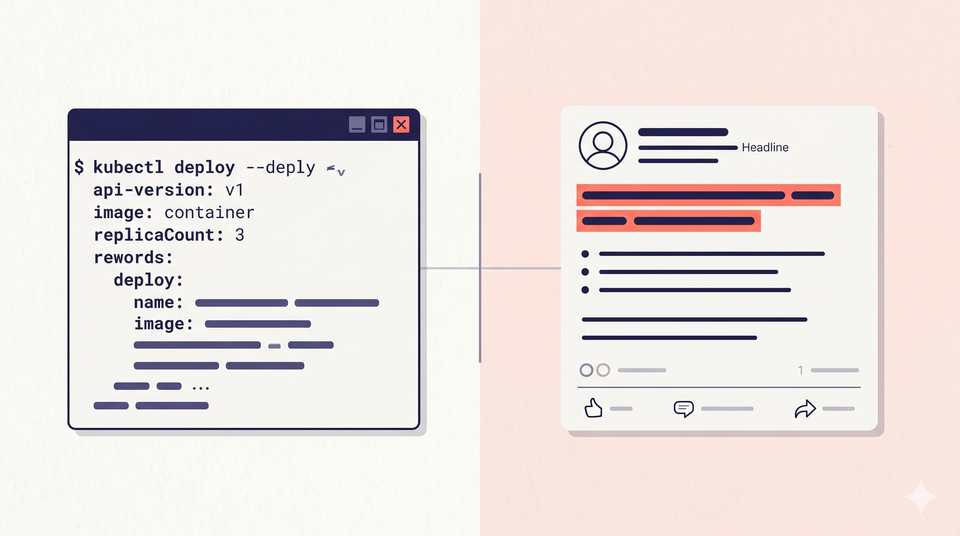
LinkedIn personal brand for software engineers means strategically sharing your technical knowledge, career lessons, and real work on LinkedIn to build professional visibility, attract opportunities, and establish credibility in your niche. Engineers who post consistently see measurable results: inbound recruiter messages, consulting inquiries, and community connections that don't come from a polished resume alone.
You've built things. You've debugged things at 2am. You've migrated a monolith to microservices and lived to tell the story. The question is why nobody outside your team knows about it.
LinkedIn has over 1 billion members, and software engineers are one of the most in-demand professional groups on the platform. Yet most engineers treat LinkedIn like a passive resume, updated only when job hunting, never actually used. That gap is your advantage, if you're willing to show up consistently.
This guide is for engineers who want visibility without performing. No motivational content. No fake vulnerability. Just a practical system for building a LinkedIn presence that feels like you.
Table of Contents
- Why Engineers Dismiss LinkedIn (And Why That's a Strategic Mistake)
- What to Post When You're Not a Content Person
- The Engineer's Content Formula
- Building Visibility in DevOps, Cloud, and SRE Specifically
- Posting Consistently Without It Becoming a Second Job
- FAQs
Why Engineers Dismiss LinkedIn (And Why That's a Strategic Mistake)
The typical engineer argument against LinkedIn goes something like this: "It's all hustle culture and people congratulating themselves. Nothing useful happens there."
That criticism is half right. There is a lot of noise. But underneath it is a real professional network where hiring decisions get made, consulting pipelines get built, and technical reputations get established long before a recruiter ever opens a resume.
Here's what most engineers miss. LinkedIn is not a job board. It's a discovery layer. When a CTO is looking for someone to run their platform engineering team, they search LinkedIn before they post a job. When a startup wants a DevOps consultant who knows Kubernetes in depth, they look for someone who's been writing about it publicly. The engineers who show up in those searches are the ones who've been building a visible track record, not necessarily the most technically skilled ones.
The practical outcomes are concrete:
- Recruiters find you instead of the other way around, which shifts leverage in salary negotiations.
- Consulting leads come inbound when you're known for a specific niche.
- Open-source projects get contributors when the maintainer has a visible community presence.
- Conference speaking invites come from people who've read your posts, not your GitHub.
The engineers who dismiss LinkedIn often have strong skills and weak discoverability. That's a fixable problem.
The numbers back this up. According to LinkedIn's own data reported by Botdog (2025), profiles that list at least five relevant skills receive 17 times more profile views than those that don't. And only 1% of LinkedIn's monthly users post content weekly — yet those users generate 9 billion impressions per week. That is an extraordinary content gap, and most engineers are sitting on the quiet side of it.
| Stat | Figure | Source |
|---|---|---|
| LinkedIn members worldwide | 1.3 billion (Dec 2025) | DemandSage, 2026 |
| Monthly active users | 310 million+ | DemandSage, 2026 |
| Recruiters who use LinkedIn to find candidates | 77% | Botdog / Soocial, 2025 |
| Users with completed profiles who get more opportunities | 40x more likely | LinkedIn (via Botdog) |
| Profiles with 5+ skills: profile view increase | 17x | LinkedIn (via Botdog) |
| Weekly content posters vs. impressions generated | 1% of users → 9B impressions/week | Kinsta / Botdog, 2025 |
| Video content engagement vs. text-only | 5x higher | DemandSage / ColumnContent, 2026 |
| Engineers in top job functions on LinkedIn | Top 3 (alongside sales and operations) | LinkedIn Pulse, 2024 |
Sources: DemandSage LinkedIn Statistics 2026 · Botdog LinkedIn Statistics 2025
What to Post When You're Not a Content Person
The blank screen problem is real. Most engineers stare at LinkedIn, open a draft, write "Today I learned…" and then close the tab. The issue is not a lack of things to say. Engineers have more material than almost any other professional. The issue is not knowing what format that material should take.
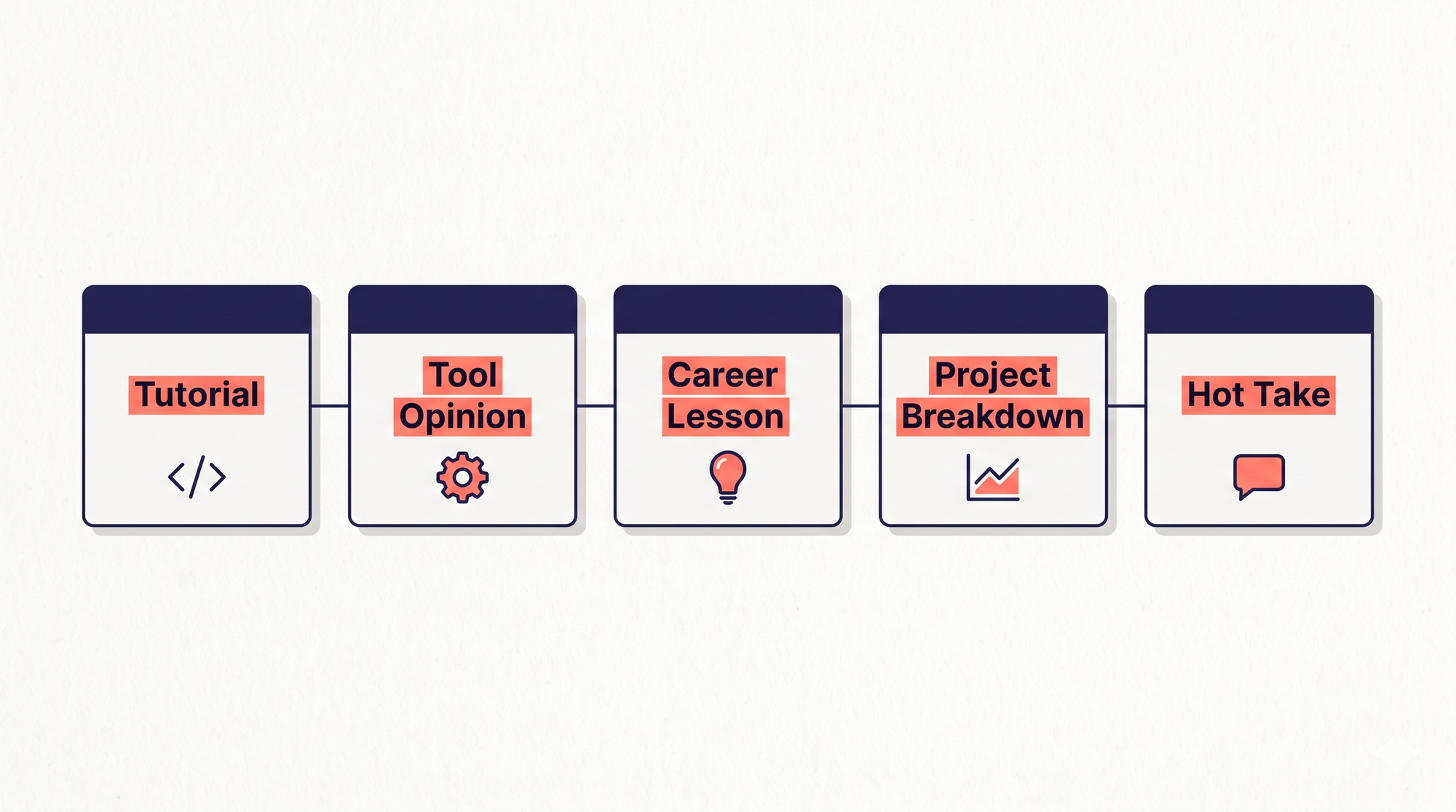
Here are the formats that actually work for engineers on LinkedIn, with examples for each:
Tutorials and walkthroughs — You set up a GitHub Actions pipeline for zero-downtime deployments. Write the post like you're explaining it to a junior colleague. Problem, steps, gotchas, result. That's a post.
Tool opinions — You've been using Terraform for two years and recently tried Pulumi for a greenfield project. What surprised you? What would make you switch permanently? That's a post. Engineers read tool opinions obsessively.
Career lessons — You got your CKA on the third attempt. What was different the third time? Specific preparation changes, not generic "you can do it" content.
Project breakdowns — You reduced p99 latency by 40% in a microservice. Walk through the approach: profiling, hypothesis, change, result. Engineers love real numbers.
Hot takes on tools or practices — "Helm is overengineered for 80% of use cases." That's a post that will get 50 comments, half agreeing and half not. Both are good.
The common thread: specificity. The more concrete the detail, the more credible and useful the post. Vague posts about "the importance of resilience" disappear. A post about what happened when your Redis cache failed at 3pm on a Friday and how you diagnosed it stays in people's memories.
The Engineer's Content Formula
Engineers overcomplicate content creation. The real structure is simple and repeatable.
Problem → Solution → Lesson
That's it. Every good technical post on LinkedIn follows this pattern, even when the author doesn't consciously structure it that way.
Start with the problem. Be specific enough that the reader immediately recognizes it: "Our Kubernetes cluster was hitting OOMKilled errors on three pods every morning between 6 and 8am. We had no idea why."
Then show the solution. Not just "we fixed it" but the actual process: what you checked first, what you ruled out, what the actual cause was. The messy middle is what makes engineering content credible. Anyone can write about success. The diagnostic steps are what people screenshot and save.
Then extract the lesson. What would you do differently next time? What does this tell you about the system or the practice? This is where you move from documentation to insight, and insight is what builds reputation.
This formula works because it mirrors how engineers actually think. It's not storytelling for the sake of it. It's structured problem-solving made visible.
One practical addition: end with a question. "Has anyone else seen this pattern with memory limits in Kubernetes? What was your diagnosis?" Questions extend the post's life in the algorithm and bring engineers into the comments who have similar experiences. Those comments are often more valuable than the original post.
Building Visibility in DevOps, Cloud, and SRE Specifically
The DevOps, Cloud, and SRE space on LinkedIn has a specific audience: engineers at every level, engineering managers evaluating tools, founders assessing vendors, and recruiters filling specialized roles. Knowing who reads your content shapes what you write.
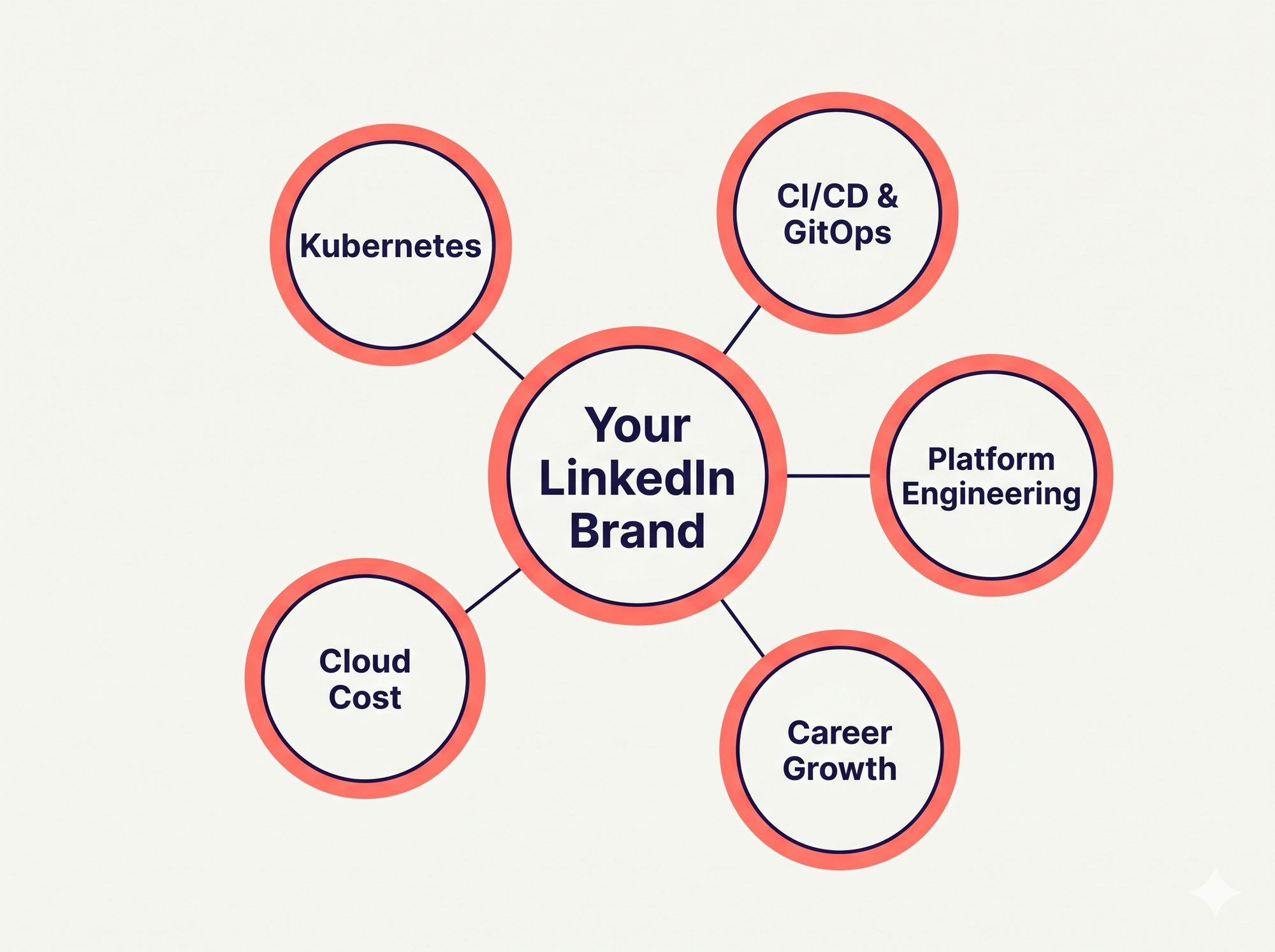
The subtopics that consistently get traction in this niche:
Kubernetes and container orchestration — Still the most searched topic in the platform engineering space. Posts about real-world K8s problems: RBAC misconfigurations, node affinity issues, resource quota management. The closer to production reality, the better.
CI/CD and GitOps — "How we moved from Jenkins to GitHub Actions" or "What ArgoCD taught us about deployment hygiene" posts land well. Specific tool transitions with real tradeoffs perform better than generic advocacy.
Platform engineering and internal developer platforms — This is a rising topic. Engineers building IDPs who write about what they're building and the decisions behind it are establishing early authority in a growing category.
Cloud cost optimization — Every engineering team is fighting cloud spend. Posts with actual numbers ("we reduced our AWS bill by $8,000/month by doing X") get shared constantly.
Career growth for engineers — "How I went from SRE to Staff Engineer in 18 months" or "What I look for when reviewing a DevOps portfolio" posts bridge the technical and career audiences, expanding reach without losing credibility.
One important note on niche strategy: don't try to cover all of these at once. Pick two or three adjacent topics and go deep. Breadth makes you a generalist. Depth makes you the person people tag when a specific question comes up.
Posting Consistently Without It Becoming a Second Job
The biggest failure mode for engineers who try LinkedIn is inconsistency. Three posts in a week, then silence for six weeks, then three more. The algorithm doesn't reward bursts. It rewards steady cadence.
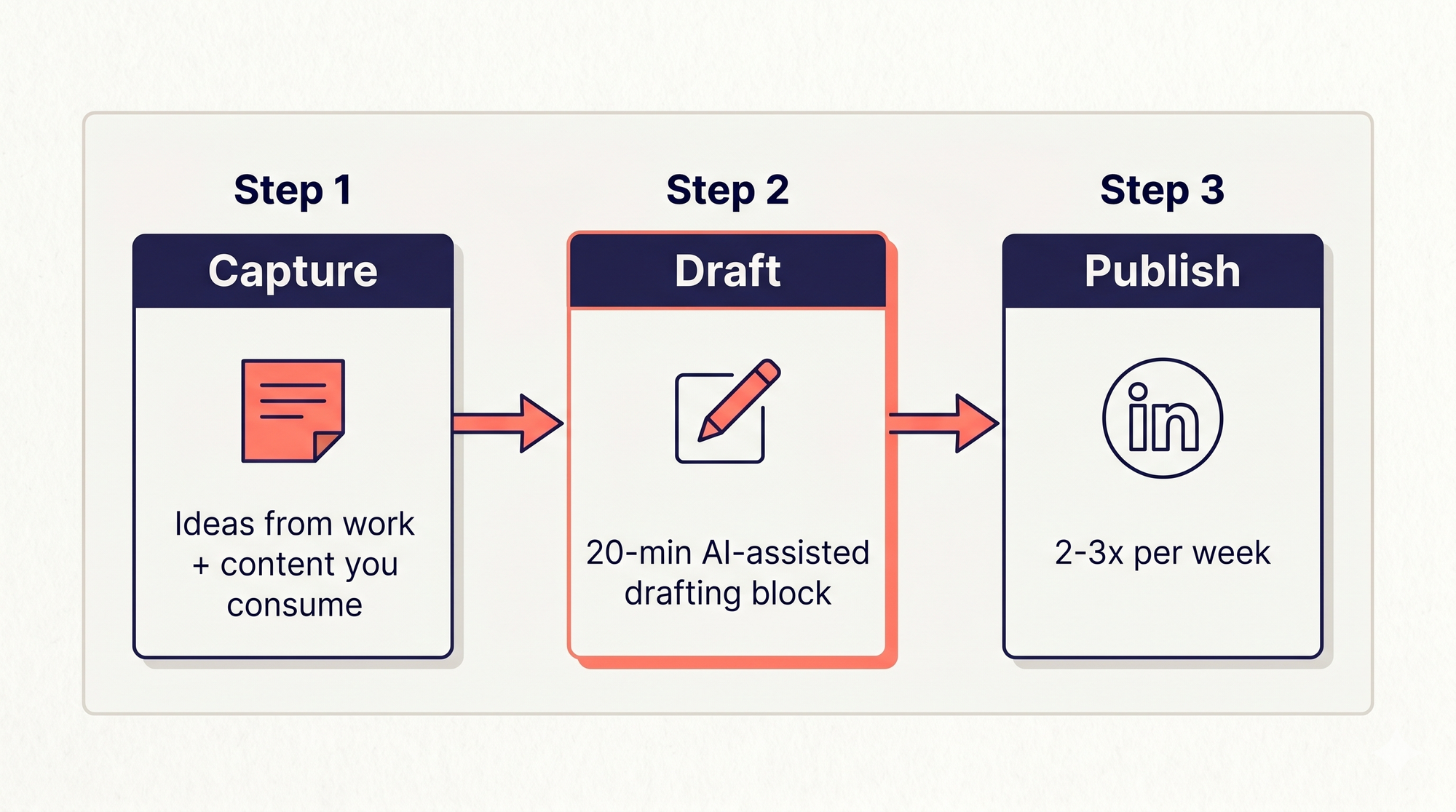
The realistic target for most engineers: two to three posts per week. That sounds like a lot until you have a system that generates draft content from what you're already consuming.
Time-boxing approach
Set a 20-minute block twice a week. Not for writing from scratch but for reviewing and refining. The idea capture happens throughout the week as a low-friction habit: when you fix something interesting, when you read an article that changes how you think about something, when you have an opinion about a tool update. Capture the raw material in a note. The 20-minute block turns raw material into posts.
Using AI tools that sound like engineers, not marketers
Generic AI writing tools produce content that sounds like a press release. "In today's rapidly evolving technology landscape…" No engineer talks like that, and LinkedIn audiences can tell.
Tools built for personal brand, like CannerAI, are different because they're trained on your existing voice. You feed in a topic or a YouTube video you watched, and the output matches how you actually write. Engineers who watch technical YouTube content heavily (Kubernetes breakdowns, cloud architecture reviews, tool comparisons) can connect those channels directly to CannerAI via Connectors and get post drafts generated automatically when new videos publish. You review, edit if needed, and post. The research step is eliminated.
That combination capturing raw material throughout the week, using AI to produce a voice-matched first draft, reviewing in a short time block gets consistent posting down to under 30 minutes per week once the system is running.
What to do when you have nothing to say
This happens. The fix is not to force inspiration. It's to fall back on formats that don't require original insight:
- Share a tool you started using this week and your first impression
- Post a question to the community about a problem you're actively working through
- Share a resource (paper, talk, documentation) with one sentence about why it matters
These posts don't build reputation as fast as original insight posts, but they keep cadence alive, which matters more in the short term.
FAQs
How do I build a LinkedIn personal brand as a software engineer?
Start by posting two to three times per week about things you're already doing: problems you've solved, tools you've evaluated, lessons from recent projects. Use the problem-solution-lesson structure to make each post concrete and useful. Consistency over six to eight weeks builds more authority than a burst of ten posts followed by silence.
What should engineers post on LinkedIn to grow their following?
The formats that work best for engineers are tutorial walkthroughs, tool opinions with specific tradeoffs, real project breakdowns with numbers, and career lessons. Posts with concrete technical detail consistently outperform vague thought leadership. A post about diagnosing a specific Kubernetes memory issue will reach more relevant people than a post about "the importance of reliability."
How often should a software engineer post on LinkedIn?
Two to three times per week is the realistic target for most engineers who aren't professional content creators. That cadence is enough to stay visible in the algorithm and build a consistent body of work without making content creation a second job. Quality and specificity matter more than volume.
Do DevOps engineers need a personal brand on LinkedIn?
Not strictly, but the engineers who invest in visibility in the DevOps and Cloud space find that inbound opportunities (recruiter conversations, consulting inquiries, conference invites) become far more common. In a field where specialized skills are in high demand, being discoverable is a career asset. The alternative is waiting for a job posting and competing in a pool.
Can I use AI to write LinkedIn posts as an engineer without sounding fake?
Yes, but only if the AI tool is trained on your voice. Generic AI output sounds generic. Tools like CannerAI learn your writing style and generate posts that match how you actually communicate. For engineers who consume a lot of technical YouTube content, CannerAI's Connectors feature can automatically draft posts from videos in your niche, which you review before publishing.
What LinkedIn topics get the most engagement in the DevOps and Cloud space?
Kubernetes troubleshooting, CI/CD tool transitions, cloud cost reduction case studies, and career growth content for engineers consistently get high engagement. Posts with real numbers perform better than general observations. Platform engineering is a growing topic with a relatively small number of established voices, which makes it a good niche to build authority in now.
How long does it take to see results from LinkedIn personal branding?
Most engineers start seeing measurable results, increased profile views, inbound messages, comment engagement within six to eight weeks of consistent posting. Follower growth is slower and less important than the quality of attention you attract. One inbound message from the right hiring manager or potential client is worth more than 500 passive followers.


Member discussion